Disrespectful Expectations

Several weeks ago, a friend told me this story about an interaction between her tween son and her mother. Since many of us are gearing up for big family events tomorrow, this topic is something worth thinking about. My friend, a 30-something-year-old Black mother of two in Texas, had this to say:

So today she apparently asked my 12 yr old if he could help her get 2 gallons of water from her car and he said no. She came to snitch and I’m sure was trying to embarrass him and I just said “I’ll help you.” He seemed annoyed she interrupted our conversation to tell me that. My family has no respect for children. I honestly assumed he didn’t feel like it. He had just gotten home and rode his bike from school today and he was getting his snack together. I wouldn’t want to stop preparing food to get water either when it can wait. It wasn’t perishable food she was asking for help with but it honestly didn’t matter to me. I teach them ‘you can always ask but sometimes the answer is no.’

She explained further that there is some background between her son and her mother. It seems she oversteps her bounds and tries to impose her ideology on the children. My friend’s son receives her actions as judgmental. When she asked “Do you want to help me with something?” he answered literally “No” because he was busy.

I can almost see the pearl-clutching! I come from a very Southern, very authoritarian background where adults owned all rights to the labor of children and children had no right to refuse. It was considered the height of rudeness and deserving of quite a spanking. I’ll grant that a young boy who had the strength to ride his bike all the way home from school surely has the strength to go outside to grab a couple gallons of water. Plus, it’s perceived as rude not to be considerate of an elderly relative’s wishes.

Before we had our children, Peaceful Dad and I created family guidelines, and one of those guidelines is “We always choose to help.” We teach our children that we are the heart and hands of Christ to our world. We help out of love. Not obligation. And never because someone wants to assert a flawed belief that my children should be subordinate. I don’t entertain discussing my kids negatively like this grandmother did, no matter who the adult is. I will always ask the adult to speak directly to my child if there’s been a problem. I can be there for moral support, but my child needs to be part of the conversation.

Had this scenario happened in my house, I probably would have broached the topic with my son to understand his perspective while affirming that no one is obligated to help anyone. I would want my son to know that there are relationship consequences for refusing a request for help, particularly since there exists a social expectation that children are to serve adults. This is something children need to be aware of, and it’s something worth discussing as we guide our children through the trials of childism.

Her entitlement was completely inappropriate. No one has a right to anyone else’s labor. I imagine my friend’s son would have graciously agreed had his grandmother asked, “When you finish eating your snack, would mind helping me get some gallons of water out of my car?” So, let’s flip this around. Is it not also rude of an adult, knowing this child was tired and hungry, to demand assistance with a non-urgent matter while the child is in the middle of making himself something to help him recover from his long day and his long ride? Could the request not have been made in a more understanding and compassionate way wherein both of their needs could have been met?

The trouble here is that, for many adults, the outcome isn’t as important as the interaction. They say they like seeing kind, cooperative, and respectful children, but what they really expect is deference and obedience.

That’s childism!
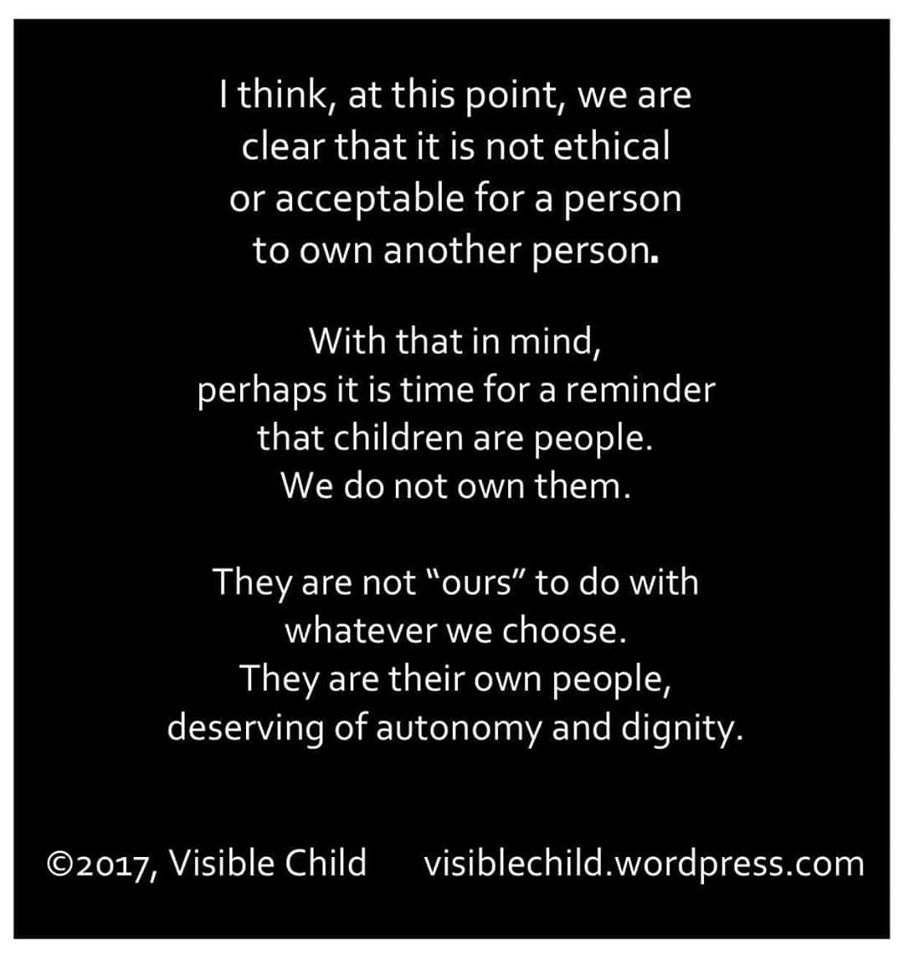
Rudeness is a matter of perception. In this case, the requester ultimately got the help she was requesting, so the problem was solved. I don’t want to suggest that kids be encouraged to break social “rules” for the sake of being controversial. I think it’s important for children to be aware of expectations and cultural consequences. But, at the same time, we also need to be holding adults accountable for how they interact with kids, and we need to instill self-confidence and self-worth in our kids so that they know how to navigate social expectations with grace and wisdom.

If a child is uncomfortable with a request being made of them, we can be there to help guide the conversation. Otherwise, we can give kids room to work out their own relationships and support them in upholding boundaries… even with elderly relatives. And, even at big family events.

I asked my friend what had changed since her own childhood that caused her to support her son in his interaction with her mother. She said:

In the past I would have felt pressured into forcing him to do something he didn’t want to do. When my daughter came along I realized that I was raising my kids differently than I was raised and than the kids in my family were being raised. One day my grandma asked my 1 year old for a hug at easter and my nephew who was about 4 said she “don’t do hugs.” My granny said “I don’t care, come give me a hug girl!” It was right then that I was like “oh hell no!” She is not about to force herself onto my child and traumatize her and then leave me with the job of cleaning up. So I stopped her in that moment and said “we don’t force physical contact on people,” and I looked at my daughter and said “can you wave bye bye to granny?” And she didn’t do that either and I said “maybe next time” and shrugged it off. That’s when I started looking into ways to fend off my pushy relatives because I knew there would be more situations like these in the future.

I went from spanking my son to not believing it was necessary I hardly ever took my kids out during nap time or would leave when they got tired because they just slept better at home and to prevent putting them in situations where they were over tired and would act out. Long ago, I decided that just because something is the way we’ve always done it, that doesn’t mean it’s not wrong.

Just because something is the way we’ve always done it, that doesn’t mean it’s not wrong. That is an entire lesson right there on its own! We can teach our children how to say, “I’m busy right now, but I’ll be with you as soon as I finish.” We can foster relationships in our children’s lives that meet their needs and those of the adults they care about. When the challenge in a child’s life is a social expectation, let’s allow genuineness and honesty to win out. It’s ok for children to say “not now” or even “no” to adults. Unclutch those pearls!

So, how do you instill a sense of selflessness in your kids? How do you foster the development of a human who enjoys being helpful whenever possible? I’m sure there are many ways families are doing this every day (and I’d love to hear from you in the comments!) I’ll mention one of the ways that has been invaluable for my family. We include our children in our everyday lives. Sounds pretty simple, but it takes planning and patience. It can be difficult to allow kids to help in their own developmentally appropriate ways. It’s messy and time consuming, but it is wonderfully affirming for your child! If you’d like to try it out, the key is to resist the urge to do things for your children. Don’t take over. If you want to insert yourself into the activity, help out! Demonstrate by modeling what’s expected. Openly speak with your child about the expected outcome, step by step. Children don’t know the process to get to an end result until they learn it. For example, including children in putting laundry away might look something like this:

  • Parent invites the child to help
  • Child accepts
  • Parent quickly explains what’s about to happen – “We’re going to take the clothes out of this laundry basket, fold them neatly, put them back into the basket, and then put them into their drawers. I’ll help you!”
  • Parent demonstrates how to fold an item of clothing and hands some clothes to the child
  • Parent and child go through the steps together

Many children will likely not be able to fold to an adult’s expectation, be able to open drawers and sort, and the like. Some direction is helpful, but allowing the child to try and accepting their effort as is goes a long way to instilling a love of helping in a child. And, start young. Thank your infant for helping you pick up toys even if it becomes a game. There are so many ways to include and appreciate kids. You and your child will figure it out together.

One Cure for Whining

Want to know something pretty incredible about whining? Researchers have posited that it may actually be an evolution of crying at a time when children “switch from primarily mothers to greater care from other caregivers.” That means whining serves an evolutionary purpose in communication between young children and adults. Kids who whine when resources are limited tend to be heard and that means they tend to survive. Pretty clever, huh? But, stressful nonetheless.

I know my title mentions a “cure” for whining, but in reality, whining is good as far as I’m concerned. It signals that a child is emotional, under or over-stimulated, or just plain done. That kind of information can help you be an even more responsive parent. Whining tells you there’s a need waiting to be met and, if you can pinpoint what it is, you can avoid a meltdown. Before you do anything else, make sure your child’s basic needs are squared away. Hunger? Thirst? Discomfort? Tiredness? Sometimes, all it takes is addressing the underlying situation to resolve the cause of the whining.

However, when that’s not possible or when you can’t determine what the issue is, there’s another trick you can keep up your sleeve. The surprisingly powerful “First/Then” statement. It works in just about every context. Let’s say your child wants to go outside to play, but there are toys everywhere. You might say, “Not until you clean up.” That’s a pretty amorphous statement when you think about it. “Not until you clean up.” There’s no direction. No time frame. No, point a to point b.

Back in the late 1800s, Pierre Janet – a French psychologist who specialized in dissociation and traumatic memory – set out to explore the phenomenon wherein we feel like time passes more quickly as we get older. He came up with the “ratio theory” which suggests that the smaller proportion of our lives that remains, the more quickly we feel we’re hurtling toward the end. There are other theories about the phenomenon, some say it’s memory, others our biological clock. Whatever the truth is, one thing is for sure. Time moves at a snail’s pace for children. We can be sensitive to that even as we establish limits for our kids.

Back to cleaning up those toys. Giving children more of a clear directive without attempting to control their every move often helps motivate them and reduces their need to whine in order to be heard. In our scenario, you might consider saying, “First, I need for you to pick up your toys and put them where they belong. Then, you’re welcome to go outside and play until the sun goes down.” You’ve given your child a task list to check off, time-related landmarks, and the power to choose how long to do the task you’ve given. And, if you really want to level up on your Peaceful Parenting, offer to help your child clean up! The very best cure for whining is to meet your child needs.

Gentle Support for Your Resistant Child

Much of the information available about Peaceful Parenting assumes your child is neurotypical and is responsive to your relational overtures. But, what happens when your child resists your every attempt? What do you do when connection hurts?

I’ve collaborated with two dear friends of mine for this post. One friend is a mom who lives in Scotland and has a son with debilitating anxiety and psychomotor overexcitability. And, the other friend is a mom who lives in South Africa and has a daughter with an unofficial diagnosis of Pathological Demand Avoidance (PDA). I’ll be using country abbreviations to refer to each with Scotland being SCT and South Africa being ZA.

Peaceful Parenting for Anxiety

We all three believe that Peaceful Parenting works for all kids, but we also recognize that a single approach will not foster connection with every child. The standard steps apply: create your own peacefulness, assess your child’s needs, foster your child’s emotional equilibrium, empathize with your child, and set gentle, reasonable limits. However, parents can stall out at that second step with their resistant kids. What are the deepest needs of a resistant child?

Kids with PDA, traumas, and other anxiety-fueled differences desperately want to connect with their caregivers, but the barriers can be insurmountable for these children to overcome on their own. Anxiety plays a massive role across a number of challenging childlike behaviors, and it’s something we can all understand. The trick is finding the unique approaches that can cut through the chaotic fog of anxiety and let your child know they are safe and wanted.

Anxiety can present in classic ways and not-so-visible ways. For many adults, anxiety manifests as talking incessantly about worries, overthinking and overanalyzing situations, indecision, being “wound up” and unable to relax, trouble concentrating, insomnia, sweating, gastrointestinal problems, and unexpected anger.

Kids often don’t know how to express their anxiety. They may complain of stomachaches or headaches a lot. They may be perfectionists. They may spend an inordinate amount of time doing small things and focus on minute details. They may delay beginning new activities. And, they may avoid social engagements. In small children, who are even less able to communicate their concerns, anxiety may also show up as things like stalling, becoming mean or aggressive, finger/toe/nail/lip/eyelash picking or biting, hair twirling, and inflexibility about their desires and/or their environment.

Sourced from Gozen.com

My friend, SCT, has learned the signs of her son’s anxious dysregulation and what she can do to help him. She says,

What I’ve found so far, and it seems to work at school too, is starting with a hands off approach. Redirecting him to go read for 15 to 20 minutes just recentres his brain. That’s if the anxiety is in the disruption phase. Funny noises, shouting, silliness, maybe something physical like jumping around. That’s usually come about as a result of being overstimulated and struggling to output it. The other little things are lip picking and adjusting his glasses repeatedly. After he’s had the quiet time, he’s more reasonable to talk to and have a cuddle.

In ZA’s case, she realized her daughter was different from infancy. She didn’t like to cuddle and would get stimulated quickly. As she grew up and became more independent, she also became happier. ZA and her husband gave their daughter plenty of respect and autonomy from a very young age, but she grew more and more resistant over time. At first, they tried common Peaceful Parenting techniques like naming feelings and hugging, but she would become enraged. They tried time outs which caused extreme separation anxiety. In their desperation, they even tried popping her on the hand, which inflamed the resistance further.

ZA learned, in speaking with professionals, that talking about feelings exacerbates anxiety in some children who can’t identify their feelings because that uncertainty is debilitating. However, it’s critical for anxious children to learn how to process feelings. It’s a very tough situation. If you’re experiencing what ZA did, she has a message for you.

Trying to explain this to the well meaning moms taking time to try and help me was either met with silence or a “Sorry, I don’t know then”, so for the most part our journey has been quite lonely as nobody understood what we were going through. It wasn’t until I found out about PDA that I’ve been able to get some advice that is applicable to us or at least some genuine understanding without raised eyebrows.

My advice for parenting a child like this is to study them and see what their tells and triggers are. Work on emotional intelligence as much as possible and teach them to recognize the signs when things are becoming too much. When they explode, dissect the hours leading up to it cause I can promise you it’s most likely been building a while. Listen if they tell you to leave them alone or to stop talking but check in and remind them you love them even when they are having a hard time. Read The Explosive Child by Ross Greene. Adjust your way of thinking how parenting should look, sometimes “giving in” is exactly what your child needs and isn’t seen as a weakness but as kindness. Be flexible, very flexible. Work on your own shortcomings and be kind to yourself when you stumble.

It is really tough parenting a child who doesn’t respond to the typical peaceful parenting strategies. It’s the toughest thing I have done in my life. In saying that, my daughter has driven me to become a much better parent and person. She’s challenged me in ways that I never thought possible and has made me grow immensely. She is an amazing, caring, insightful, funny, smart human being underneath all of her anxiety and I honestly wouldn’t trade her for anything. I can see everyday how she is growing and becoming a more confident little girl.

If you have concerns about your child’s behavior, and common Peaceful Parenting techniques aren’t helping, please consider seeing a professional for an assessment. Peaceful Parenting works for every child and every parent, but the approaches and techniques you choose have to be adapted to your child’s individual needs. Unless you figure out what your child’s needs are, you may both end up frustrated unnecessarily.

What You Can Do to Connect

Start With Empathy

Understand that your child isn’t being difficult, but rather is having difficulty. Respect your child’s feelings by not minimizing their discomfort. Rather than telling them not to worry or saying things like “You’ll be ok. It’s not that big a deal,” try to acknowledge the worry without amplifying it. Simply saying “I’m here and I won’t leave you alone” communicates a great deal to an anxious child.

As an adult and an onlooker to your child’s situation, you have a perspective that can be lifesaving. You can see if your child’s basic needs are being met and resolve any issues there. You can display empathy and let your child know you accept them as they are, anxiety and all. You can stand up for your child around other people. Instead of saying, “my child is just shy” or making other excuses, state what your child needs. “My daughter doesn’t want to play right now.” Period. Giving your child permission to boldly state their position is crucial to their ability to establish appropriate boundaries in their relationship with you and with others.

Create a Calming Area

When anxious children become dysregulated, they can’t ground themselves even if though they want to, and your efforts to intervene may escalate the crisis. That’s where a calming area can help. Create a kid-friendly space with a tent or even a blanket draped over two chairs. Put a pillow down and add in some chill out items like books about feelings, a sensory bottle, headphones or earplugs to quiet the environment, a compression or weighted vest, stress balls, sound therapy like a white or pink noise machine, or anything you’ve found that helps your child.

During calm times, before a crisis hits, ask your child if they want their calming area to be in a bustling family room or in a quiet, secluded room. It’s critical your child feels that this space is a refuge and not a punishment.

Respect Their “No”

Kids who are resistant often feel that they don’t have control in their lives, so they say “no” to protect themselves from becoming overwhelmed. It’s not meant as a challenge to you as the parent. You can respect their “no” while still communicating your requests. With my own kids, I typically set boundaries by saying things like “I can’t let you do that” but for a child with PDA, that simple statement feels far too controlling. Making requests as opposed to demands or other non-negotiable statements can help. “Would you [insert what you want the child to do]?” Or, “After you have finished what you’re doing now, could you [request].”

Model Cooperation and Appreciation

Use words like “we” and “us” to present tasks and acknowledge how difficult it is for the child to comply. “Let’s clean up together! Would you like to pick up toys or take these dishes back to the kitchen?” While you work together, offer affirmations like, “Cleaning is so much better when you do it with me. Thank you for helping!”

Social Stories

Social Stories are a social learning tool developed in 1990 by an educator called Carol Gray who came to understand that her Autistic students were missing information about common interactions and just needed someone to communicate that information in a logical way. It’s difficult being Autistic in a world where allistic people seem to automatically understand how things work. Social Stories help to bridge the communication gap between Autistic and allistic people.

However, Social Stories aren’t just for Autistic people. They help overcome all sorts of communication barriers and, because they involve pre-planning, you guessed it, they can help decrease anxiety too.

In this video, speech-language pathologist Carrie Clark delivers a comprehensive explanation of what Social Stories are, why they work, and how to create them. Please be aware that the very beginning of the video includes a mention of ableist functioning labels. Closed captions are available with this video.

The PANDA Approach

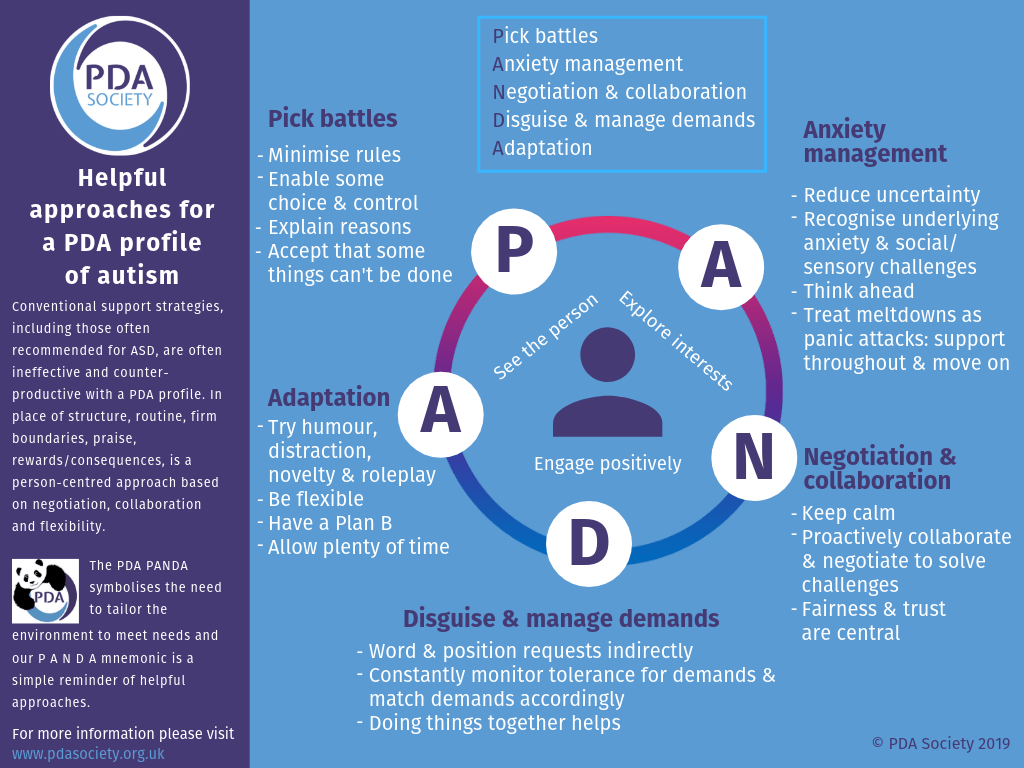
Consider the PDA Society approach, which helps to reduce resistance in anxious children. PANDA stands for Pick Battles, Anxiety Management, Negotiation & Collaboration, Disguise & Manage Demands, and Adaptation, and these tactics can be useful for other resistant children as well.

And, Here’s What ZA Does!
  • Read stories that highlight feelings
  • Verbalize your own feelings in front of your child
  • Share highlights and lowlights as a family every day
  • Adopt an anxiety-friendly framework to address anxiety around activities:
    • Use indirect requests (“It would really help me out and make me happy if you could do this for me”)
    • Tell your child exactly why what you’re asking of them is important
    • Point out the feelings attached to the activity
    • Ask if the activity is making your child anxious, nervous, unhappy, or scared but never in the midst of an anxiety attack
    • Ask your child why they think they’re having these feelings, if your child is receptive
    • Write social stories together describing step by step how the activity would go
    • Give your child space when it all becomes too much and give it plenty of time before you decide whether you should all move on or if you should address what happened

Final Thoughts

Your relationship with your child and your ability to ease anxiety can open the door to a genuinely fulfilling experience for both of you. For more tips on calming your anxious child, check out this Motherly article. And, for another fantastic resource, visit Anxious Toddlers (it’s not just for toddlers!) Please tell us what helps your anxious child the most and if there are any other resources we should know about.

Would You Devastate Your Child for $100?

How about $50? Less? I’m a numbers person and money motivates me. Not that I seek to hoard it, but that I’m careful to value it appropriately so that my family can stay afloat. I handle the family finances, so money is always on my mind.

This afternoon, my kids were having popcorn as a snack. It’s a choking hazard, but they love it, so I try to make sure they remain seated and calm so they can focus on chewing and swallowing. LL asked me for a treat that we didn’t have, and I tried to explain that to her. She flew into a rage (she’s so my child!) and knocked both her popcorn and her juice onto the floor. I ran into our adjoining kitchen to get cleaning supplies, all the way speaking empathetically to her. She really wanted that treat. She was tired. She lashed out.

In the 20 seconds I was gone, she managed to get onto the table, scurry across it, and toss her brother’s popcorn on the floor too. I came back and he looked shocked. I could see how far gone she was. She needed help. But, to be honest, I was irritated. My instinct was to snatch her up a little too hard and growl through gritted teeth. Something about wasting the food I prepared in this way seemed to touch something deep in me.

I angrily began cleaning up – normally, I’d have her help, but I was upset and I didn’t want to accidentally hurt her in my frustration. As I wiped up the juice on my hands and knees, I thought to myself, we have such a small food budget! This is such a waste. All for what exactly?? A little voice in my mind piped up, how much waste are we really talking here?

Well, let’s see:

  • Vegan Butter: $.14
  • Juice: $.15
  • Popcorn: $.10
  • Paper Towel: $.01
  • Salt: $.004
  • Cleaning Solution: $.003

Forty-one cents. For $.41, I had to hold myself back from yelling or being physically rough with a little one-year-old toddler who is less than 1/10 my size. It’s toxic. Plain and simple. A result of my culture, my upbringing, my inability to use the same logic center in my own mind that some part of me expects my kids to be able to use flawlessly.

This isn’t the first time I’ve sat down and worked out how much something cost that my kids wasted or broke, and whenever I find that number, it’s always heartbreaking. Earlier this year, my son accidentally broke a $200 TV when he was releasing after-school energy. I was in a great mental space that day, and I wasn’t angry with him at all.

I’ve been thinking about the difference between these two incidents. Why was I angrier over $.41 cents of popcorn, juice, and cleaning supplies than I was over a $200 TV? This is why.

Deep down, it felt like she was disrespecting the effort I had put into getting them cleaned up to eat, preparing their snack, serving it to them, treating them gently, and empathetically letting LL know why she couldn’t have the treat she wanted. Even though my logic tells me she’s not old enough to have any concept of what I was going through, those primal reactions still welled up in my chest.

In the end, I recovered without incident and sat down to cuddle with her. She was having a hard time and she needed me to help her regulate herself. It didn’t take long before she was ready to run off and play as though nothing had happened. Meanwhile, I was still reeling and working through what had just washed over me.

Maybe this technique will help you as it’s helped me in the past. When your child’s actions end up in a loss and you’re out some money, calculate the amount. Then, ask yourself, is the value of this thing worth devastating my child by yelling or hitting. I’d say 10/10 times, the answer is no.

If you need help figuring out what to do instead, please check out the two-part series, Punishments, Consequences, and Limits. Or, just have a cuddle with your little love.

6 Reasons to Stop Spanking Right Now

#1 Spanking Makes Minor Concerns Worse

Spanking carries serious risks of injury to children. Not only can it slow developmental growth, but there is no study demonstrating that it enhances developmental health. And, sadly, harsh spanking has been correlated with a physical decrease in gray matter within children’s brains. This year, the American Psychological Association issued a strongly worded statement about corporal punishment warning of the danger of “increases in children’s behavior problems, even after controlling for race, gender and family socioeconomic status.” The American Academy of Pediatrics also strongly recommends against spanking.

#2 Spanking Amounts to Bullying

StopBullying.gov defines bullying as “unwanted, aggressive behavior among school aged children that involves a real or perceived power imbalance. The behavior is repeated, or has the potential to be repeated, over time.” With the exception of the qualification that bullying involves only school aged children, this definition fits. Not only that, but there is evidence that spanked children are at a higher risk of becoming bullies themselves as a result of their treatment by adults.

#3 Spanking is Domestic Violence

In nearly every state in the U.S., spanking (i.e. corporal punishment) is specifically excluded from state laws against domestic violence and child abuse. If spanking weren’t violence against children, there would be no need to affirm a parent’s right to hit. Only one state, Delaware, has effectively banned spanking and, even there, lawmakers made a point to say that they were not limiting parents’ ability to physically punish their children. It then stands to reason that spanking may lead children to commit domestic violence themselves later in life and, in fact, there’s evidence that this may well be the case. In 2006, the United Nations Committee on the Rights of the Child reported that “Legalized violence against children in one context risks tolerance of violence against children generally” and a study out of Canada found that most child abuse occurs during physical punishment.

#4 Spanking is an ACE

A study published in Child Abuse & Neglect, the official journal of the International Society for Prevention of Child Abuse and Neglect, lays out the case for spanking being designated an Adverse Childhood Experience (ACE). ACEs are linked to myriad regulatory complications for children that are then expressed as undesirable behaviors. Watch this interview with Dr. George Davis, who served as the lead psychiatric clinician for New Mexico’s Juvenile Justice System for 20 years, in which he explains the connection between ACEs and interaction with the justice system. Almost all the children studied as part of the New Mexico Juvenile Justice program had experienced corporal punishment at the hands of caregivers. Spanking does not prevent incarceration and may, in fact, contribute to it.

#5 Spanking Affirms White Supremacy

Dr. Stacey Patton, child advocate, is a woman who understands the risks of spanking first-hand. She is an adoptee, child abuse survivor, and former foster youth who has become an impassioned voice against the ritualistic practices around spanking as punishment. In her research, she has discovered that “Europeans brutalized their own children for thousands of years” before colonizing the Americas and Africa; and therefore, that spanking is not intrinsic to every culture around the world. Instead, it is far more likely a practice with deep ties to colonialism and white supremacy.

#6 You Already Know It’s Wrong

Despite the very high levels of support for spanking in the U.S., many parents express regret at feeling compelled to engage in the practice. The widely identifiable sentiment, “This hurts me more than it hurts you,” reveals the emotional burden parents experience when they physically harm their children in pursuit of good parenting. A quick Google search of “spanking regret” reveals just how widespread the discomfort is.

The Good News

You do not have to spank. Period. You do not have to do it. There are effective alternatives. Even though Peaceful Dad and I don’t employ time-outs or any punitive measures, I have no qualms telling you that research shows time-outs work in the short and long run. Science has effectively proven that time-outs are more effective and less harmful than spanking. So, if you must punish, please use time-outs. If you are looking to move past punishments, I invite you to continue following this blog and/or check out the Resources section for more ideas.

The Bad News

Efforts are underway nationwide to ban spanking in the U.S. That, in and of itself, isn’t a negative thing. If spanking were made illegal, hundreds of thousands of children would be spared the negative long-term consequences of physical violence. If we took this step, we’d be joining 54 other countries worldwide, nearly 30% of the globe, in leaping forward into a new era.

But – and this is a massive caveat – given the racial disparities in our legal system, parents of color would be disproportionately affected by these bans. Black parents, in particular, spank at rates nearly double that of white and Latinx parents. Black people are also far more likely to be arrested, charged, and sentenced than any other group, and their sentences are substantially more extreme.

Furthermore, Black children are more likely to be removed from their homes and placed in state care than other groups, even for relatively minor offenses. It would be utterly irresponsible of us to advocate for blanket spanking bans knowing that people of color would be drastically impacted. If we do move to ban spanking, we must keep families out of the court system and away from child services. 

I admit that I don’t have the answers here. I don’t know what to do. I know we have to protect kids, but I also know we have to protect their parents. And, this is a key reason I am so adamant about giving people alternatives and showing, through the experiences of my family, that gentle methods really do work.

Curious for more on the topic of punishment? Check out Punishments, Consequences, and Limits.

Punishments, Consequences, and Limits: Part 2 of 2

Continuing from Part 1

So, what do you do when you encounter an undesired behavior after your child has already stepped beyond a limit? If not punishment, then what?

I’ll let you in on a secret. Here’s what you do: Say, “I love you no matter what you do.” Let those be the first words out of your mouth. Communicate to your child first and foremost that their behavior does not define your relationship. It doesn’t matter what the child has done. Say “I love you” regardless. Children tend to be binary thinkers. It can be difficult for them not to regard themselves as either good or bad without much gray area in between. They need to know that they are loved, no matter what.

After your child understands that your relationship with them is secure regardless of the outcome, the work begins. If their actions have resulted in harm, they need to be given an opportunity to rectify what’s happened. And, whether or not their actions have resulted in harm, they need the chance to create and implement a plan for the future. No punishment needed.

Restorative Practices

Children do not inherently know how to be in relationship with other people. They learn and they stumble… often. If your child has done something that has caused any sort of harm, incorporating restorative justice principles can help begin the healing process.

  1. Give the aggrieved parties space to communicate their perspectives. If you are the aggrieved party, bring in a neutral arbiter to help.
  2. Employ the CLAIM method to guide your child through this process.
    • C: Center Yourself. Draw in your fears of judgement and be brave.
    • L: Listen. Pay attention to what’s being said rather than preparing a rebuttal.
    • A: Acknowledge. Take responsibility for your actions (and apologize and/or make restitution if necessary).
    • I: Inquire. Ask how you can do better in the future. Keep in mind that this involves labor. The other party has a right to decline.
    • M: Move Forward. Change your behavior and teach others to do the same.
  3. Enunciate the harm that has been caused, both tangible and intangible.
  4. Confirm the resolution with all parties and establish an accountability plan with your child.
  5. Support your child through their inevitable feelings of ostracization from those they harmed. Encourage them to give it time and to be kind.

Children of all ages and neurologies can benefit from modified versions of this process. The skills you impart through this process will provide your child with the tools necessary to become versed in conflict management and active listening, both of which are critical relationship skills.

Setting New Limits

Peaceful Parents try to get ahead of challenges and take proactive steps to avoid them. When challenges occur despite our best efforts, we regroup and work with our kids on resolving remaining issues and on solving the underlying difficulty before it happens again in the future. Our philosophy is that children do well when they can, and that we can equip them to do better by addressing their unmet needs and building skills.

When you learn about a challenge after the fact, try to resist the urge to punish. It can be extremely unnerving to feel like you aren’t doing anything, but I assure you, what you do instead will send ripples of goodness into your child’s future.

It’s important to talk with your child about what’s happened, opting for open-ended, non-accusatory questions like “What were you hoping would happen?” that garner a more developed response than “What happened?” Again, age will determine how far you can go.

Unfortunately, more often than we’d like, we learn disappointing truths about our kids. This can be hard for us and for them. Protecting your relationship in the face of missteps means choosing your approach carefully. Remember that children instinctively react when they are afraid. In order to reason with your child, you’ll need to keep them in a cognitive space by reassuring them that they’re safe with you.

Let’s consider a pretty common (and developmentally appropriate) difficulty for children: lying. If your child lies, you’ll be less inclined to believe what they say in the future. However, rather than undermining your relationship by saying, “I don’t trust you,” you can instead try to frame the situation in a way that can be solved. Speak factually and coach your child toward a resolution using “I” phrases to express your feelings. “I’m sad that you didn’t tell me the truth. I want to be someone you can always talk to. What can we do in the future to make sure you don’t ever feel you have to lie to me?”

In this reconciliatory space, you can help your child determine their own solutions for what to do, giving them ownership and power over their choices. Knowing that children aren’t hardwired yet for wise, measured decision-making, you can ask questions to better understand what your role will be in making sure limits are observed as part of a renewed plan for the future.

If it happens again, walk with your child through the exact same process. And, if that sounds too much like kids “getting away with bad behavior,” think about how many times parents have to turn to punishment over and over again because there is insufficient behavioral change. We’re working on moral development here. Not obedience.

Punishments, Consequences, and Limits: Part 1 of 2

Are they different words for the same thing? Does it even matter as long as children behave the way they’re supposed to? Let’s dive into this hotly debated topic and see if we can parse out the differences, the benefits, and the downsides.

First, I’d like to talk a bit about discipline. This term originated in Latin as “disciplina” and it simply meant instruction. Give a word a few centuries of cultural influence and you end up with a word that came to mean things like suffering, scourging, and chastisement in the late Middle Ages. If you don’t know what scourging means, beware because it’s nasty. It was used as a form of corporal punishment centuries ago (and, unfortunately, it’s still used in some areas of the world). A whip would be fashioned with knots or barbs to inflict the most damage possible on a person’s flesh and then the lashing would begin, mostly across the back, until the perpetrator was left bloodied and exhausted. Many people succumbed to their wounds, because they lacked the medicines they needed to treat and repair the torn flesh.

Given that trajectory, it makes sense that discipline is used today primarily to refer to physical punishment, in the context of child rearing. The steps we took to get from the intellectual pursuits of ancient Romans to the dark and brutal torture of the Middle Ages would be an interesting study. For our purposes at the moment, what I want you to know is that there is a spectrum of understanding when it comes to the word discipline and that Peaceful Dad and I land way over on the side of “instruction.”

While I can’t hope to encapsulate the entire meaning of these words in such brief statements, these self-penned working definitions will help you understand the distinctions I’ll be making later on.

  • Punishment: A negative, arbitrary ramification determined by a parent/caregiver and applied in an effort to correct unwanted behavior.
  • Consequence: A negative ramification stemming from a child’s action that occurs either without the influence of a parent/caregiver (i.e. “natural” consequence) or with the influence of a parent/caregiver in direct connection to the infraction (i.e. “logical” consequence).
  • Limit: A boundary defined by culture and/or family in the interest of safety, socialization, or education.

Punishments

Parents punish because it works. It stops the behavior in the moment and shuts the child down, so the nuisance is gone. However, punishment doesn’t work the way most people think it does.

We know that the logic center in human brains doesn’t fully form until around age 25 and that regularly coaching kids on how to reason through problems is a crucial part of teaching their brains how to think logically. However, punishment does not rely on logic. It relies on fear and control to coerce children into compliance. Children may run away, fight back, shut down, submit, cry, or become overwhelmingly exhausted when faced with punishment, especially physical punishment. You might find it interesting that these are all instinctive survival responses to stress that we all have, children and adults alike. And, if these children are not reasoning through their experiences, they may be falling back on innate self-preservation measures.

Punishment is effective beyond the immediate moment of infraction only when the enforcer is present and the punishment is severe enough to elicit strong fear. This is why, sadly, punishment can slip easily into abuse when the diminishing returns lead to escalation. Punishment is demoralizing and hurtful from the child’s perspective.

Consequences

Many parents shun punishments but desire a method of demonstrating to children that their behavior is unacceptable. Natural consequences can be a fantastic teacher. Pull the cat’s tail and you’ll get scratched. It doesn’t take a parent intervening to make that happen. Natural consequences are automatic and often unavoidable.

Children learn a great deal from natural consequences as they form relationships. When children are mean to their friends, their friends may not want to play with them anymore. That’s a natural consequence that leaves space for the child to learn how to repair a friendship. Natural consequences can be very useful, but they can also act as punishments.

Sometimes parents let natural consequences happen, knowing their child will be hurt. They want to “teach the child a lesson” (which is a surefire sign that indirect punishment is taking place). If you tell your child not to touch a hot burner on the stove and the child reaches for it, you have two choices: let the child be burned or intervene. One is cruel and the other is educational. Natural consequences don’t have to take full effect for a child to learn.

Logical consequences are selected by parents and may involve input from the child. In that sense, they are preferable to punishment. They are intended to be directly related to the unwanted behavior. For instance, a logical consequence for breaking a rule about running through the house and destroying a family heirloom might be helping to clean up the pieces and then having a time out to sit and chill.

Consequences can be effective and they can also be abused. To complicate matters further, you run into the trouble of children not recognizing the difference between a punishment and a consequence, which defeats the purpose of making the distinction in the first place.

Limits

Limits are respectful boundaries that allow all parties to be in relationship with each other and know what the guidelines are. It is possible to enforce a limit without adding on a punishment or a consequence. Limits define expectations and parents can then walk their children through how to appreciate and abide by that expectation.

The difficulty remains in terms of the child’s interpretation of a limit or a consequence. It may feel very much like a punishment to be reminded of a limit. That’s why it’s important to give the child power over the situation. Giving children power can feel foreign in a culture that diminishes the autonomy of kids, but hear me out.

Dr. Laura Markham has an absolutely fantastic primer on limit setting that I refer to often. I will try to do her justice in my explanation. For a limit to be most effective, it must:

  • be reasonable to the mind of the child (“When we throw dirt, it can get into people’s eyes and hurt them.”)
  • be explained to the child beforehand (“When we get to the park, please remember that dirt must stay on the ground and not be thrown at other kids.”)
  • be enforced consistently and with gentle firmness (“I see you’re having trouble not throwing dirt. Would you like to swing or go down the slide instead?”)
  • be under the authority of the child (“Looks like you’re still having trouble not throwing dirt. Let’s head home for now and come back tomorrow when you’re feeling calmer.”)

At any point in the exchange, the child may feel angry or coerced. Remember to remind your child of the expectations they affirmed and avoid using their behavior to assign a punishment or consequence. Your child doesn’t reason the way you do, especially if your child is under the age of six. Young children do not reliably have the ability to apply episodic memories to their future decision-making. Your young child is not considering the possibility that a consequence or punishment could result from their behavior.

What Do These Disciplinary Techniques Look Like in Real Life?

Imagine a boy called Caleb. He wants to walk to the park with his mom and his siblings to get some fresh air and play a bit. It’s a little chilly outside, but he’s all warm from being cozy in his house. He doesn’t realize that he’s going to get very chilly while on the walk and he will be unbearably cold by the time they reach the park. His mom checks her weather app and realizes it’s too cold to go without a jacket, but Caleb really doesn’t want to wear one and he tells her just that. What should mom do?

Punishment: Mom chastises Caleb for talking back and not obeying and declares that they won’t be going to the park now OR for the rest of the week.

Natural Consequence: Caleb and his family go to the park and he is absolutely miserable. He huddles down shivering while his siblings play.

Logical Consequence: Caleb and his family go to the park and he is absolutely miserable. Mom gives him a picnic blanket and instructs him to wrap up and sit on a bench while his siblings play.

Limit: At the house, Mom says, “I understand you don’t want to wear a jacket. However, I’m not willing to let you be cold. Would you like to carry a jacket or put it in a backpack to take along?” Mom won’t leave the house until she knows Caleb will be safe and warm at the park. The power to leave the house is in Caleb’s hands and the need for a punishment or consequence is avoided entirely.

Which of these techniques would you prefer to employ? What successes have you had with each? Have you run into any difficulties?

Continue to Part 2

Dysregulation and Grounding

No, not that kind of grounding! We don’t do punishments around here. By special request, I am dropping a note to provide some definitions in my own words for those who are wondering. I use the terms dysregulation and grounding, in a variety of forms, to describe some of the important steps in the process of developing self-regulation.

Definitions

  • Self-regulation: the state of being in physiological and psychological balance without external influence. Please note that self-regulation does not mean self-control. Self-regulation develops as a child builds skills to become more able to manage stress in healthy ways. Self-control means arbitrary self-inhibition whether or not the child is handling stressors in a healthy way.
  • Dysregulation: an inability to sustain physiological or psychological balance due to unmanageable stressors.
  • Meltdown: a vigorous, externalized, emotional eruption.
  • Shutdown: self-protective, internalized isolation.
  • Grounding: the process of bringing oneself back into self-regulation.

Explanation

Many of you may already be familiar with the concepts of meltdowns and shutdowns as they apply to neurodivergent children. Autistic kids are at an especially heightened risk of experiencing these very upsetting, very natural responses to living in a world in which they have to work every waking hour to operate within the confines of what neurotypical people consider “normal.” Anecdotally, I’ve found that autistic kids are more able to operate in neurotypical cultures when they have autistic adults guiding them. They’re less likely to meltdown or shutdown, probably because the autistic adults can better predict stressors and teach the kids how to avoid or work through them.

But, it’s not just neurodivergent kids who respond to stress by melting down or shutting down. Neurotypical kids do it too because, well, they are kids. Up to around age 25, we humans are pretty unskilled in the process of understanding ourselves and negotiating appropriate behavior. Meltdowns and shutdowns occur when children reach a point at which they are overloaded and unable to cope. The source could be overstimulation, hunger, exhaustion, or any number of major crises that a child cannot overcome alone.

Signs

Learning the signs of dysregulation isn’t an exact science. Caregivers should have a sense of what’s typical for a child in a given situation and, when things start to escalate, that’s when you know it’s time to act. Unfortunately, because of the way many of us view childlike behavior, it can be easy to brush off signs of dysregulation as a child just being obnoxious. However, behavior is always communication. A child may not be able to explain what’s happening, but their behavior can reveal the truth. Understand that dysregulation is never a choice. If you see any of these signs, or any suggestion that something is up with your child, take action.

Possible Signs of Impending Dysregulation
This list is not exhaustive.

  • Increasing hyperactivity
  • Increasing vocalizations (talking, humming, other sounds, etc.)
  • Increasing destructiveness
  • Whimpering/crying/whining
  • Aggressiveness/anger
  • Unusually avoidant behavior
  • Unexplained mood swings

Intervention

When a child begins to dysregulate, we adults can help. We can guide our child toward grounding by gently offering techniques that soothe at a time when our kids can no longer reason through to a solution. We become their calm. Be sure to choose interventions you know your child enjoys and ask first. Consent is crucial to ensure your child feels as calm and peaceful as possible.

Possible Grounding Interventions
This list is not exhaustive.

It’s easiest to decide what might work best for an individual child if we can figure out what’s wrong to begin with. If my child is just completely overwhelmed and unresponsive to conversation, my go to is always a hug, and then we might move onto other things. If I can see that my child is getting very sleepy, I try to create a calming environment and a place to rest (usually a nap on the couch if it’s during the day). If I can see that my child is starting to physically push people around, I look for ways to introduce heavy work. My response depends on putting together all the other observations I’ve already made leading up to the crisis.

Dysregulation isn’t bad. It’s a natural response that children have no control over. It’s our job as the reasonable adults we are to show our kids how best to cope and get back to a balanced position.

Kindness vs Niceness

A friend asked me to talk about the difference between kindness and niceness, as both concepts are used in an effort to point children in the direction of appropriate social skills. This topic had been sitting in my bank of ideas when the perfect moment arrived. Ellen Degeneres drew heat this past week when it came to light that she enjoys a close friendship with former President George W. Bush, a man responsible for the deaths of tens of thousands of people both domestically and internationally and one who chipped away at the rights of swaths of U.S. citizens. Given her claim that she is kind to all, this crisis presents a unique opportunity to take a deeper look at kindness versus niceness. Kindness has many benefits and it’s certainly a noble trait to pursue. So, what’s the difference between kindness and niceness? Is Ellen’s situation truly an example of kindness?

Dictionaries don’t offer much of a distinction, but clearly we do differentiate in common parlance. Niceness is demonstrably synonymous with politeness, whereas kindness exists in a deeper, more committed space. I propose my own definitions for the sake of clarity. 

Niceness is the quality of being polite in pursuit of respectability and maintaining the status quo. Niceness avoids conflicts and behaves in socially acceptable ways in order to reveal our best intentions. Niceness derives from humanity’s basic drive to be accepted within a social group. Clothes can be nice. Days can be nice. Dogs can be nice. People can be nice. Niceness is the overarching compliment paid to those who make us feel good. However, it can be misleading at best and fraudulent at worst. Niceness uses adherence to social standards as a means to improve a person’s social standing and, therefore, it cannot be relied upon to advance all people equally. Not when our culture suffers from disparities in equity across all aspects of identity.

Niceness brings us school flyers like this one where children are told they are responsible for the bullying that happens to them, that only they can stop it by appearing strong, and that they can hope the bully moves on to hurt another child.

Kindness, on the other hand, is active compassion and connection built out of intentional service to others. It accounts for its impacts. Kindness can be maintaining close ties to problematic people out of genuine love, and resting on the strength of that relationship to discuss difficult topics. Kindness can also be setting boundaries that limit our exposure to people who mean us harm, and using our energies instead to provide radical advocacy for oppressed people. Kindness exists in many places across the spectrum of justice. Kindness looks like states taking steps to assess children for childhood trauma (and presumably moving to include identity-based injuries, such as race-based traumatic stress, in the ACEs assessment). It looks like entire school systems addressing the problem of bullying by teaching children about boundaries, consent, and cooperation. It looks like zero tolerance policies that elevate – and at the very least believe – children who speak out against bullying while at the same time placing bullies into programs that help them work through their inner turmoil and learn better coping skills. 

In Ellen’s case, kindness could have been saying that she had found common ground with Mr. Bush, acknowledging his problematic positions, and using her proximity to him to advocate for the rights of disenfranchised people. It could have been using her white and economic privilege as a unsettling force. It could have been openly recognizing that Mr. Bush holds views that fundamentally conflict with her own. Views that inflict intentional harm on people she loves. Or, she could have joined the ranks of those who rightfully decry the massive injustices faced by enormous segments of our population.

I understand the conflict as I admittedly feel compelled to stay connected to people in order to be what may be the only contentious voice in their lives. I believe I’m responsible for using my privilege and my access to challenge my peers to abandon destruction in favor of restoration. I hope to use my voice to give them pause in the voting booth as I contextualize the effects of their choices, correct the misinformation they receive, and quell their anger that rages against the unknown.

I believe there’s kindness in connecting with the humanity in people who do harm and urging them to stop. And, I believe there is kindness in stepping back and standing up for people whose needs are not being met. Both are valid forms of activism. But, I do not see Ellen doing either as she digs in her heels regarding her relationship with Mr. Bush. I hope that she does carry the activism she wields in other areas of her life into this friendship. I hope that it’s already happening and she just hasn’t found a way to express it. And, I hope we, as Peaceful Parents, strive to understand the difference between niceness and kindness, and to acknowledge that Peaceful Parenting is going to be divisive in a culture that actively advances the status quo. Niceness is permissive. Kindness is brave.

The Peaceful Parenting Philosophy, Oppression, and Grace

It’s launch day for the blog, and I have so many thoughts spinning in my mind. Peaceful Dad and I had a conversation tonight over supper about my post on privilege. It was difficult. He reminded me that, as a white person, some people may be inclined to regard my words over those of a Black person saying exactly the same thing. He said that, while there’s not much I can do about how other people perceive me, I can and should be explicitly clear about my impetus for making controversial statements about something as sensitive as discipline in a public-facing blog; that to some I will look an awful lot like another white person colonizing a way of life. Ouch. And, he’s right. The vast majority of Peaceful Parenting “experts” are white. The vast majority of people in Peaceful Parenting discussion groups are white. I asked him if I should write at all and he said he couldn’t answer a binary question like that. He said that there’s value in what I’m doing, but that I should accept rightful criticism from people who don’t experience the world the way I do. 

I will absolutely grant that Peaceful Parenting is a special interest of mine. The philosophy and all its manifestations show up in my dreams, in my conversations, in my writing, and in every encounter I have with my children. It’s an extension of my world view… of my faith. I probably speak with too much authority about it and offer advice where I’m neither wanted nor needed. I will be working toward waiting for an invitation to offer my perspective rather than jumping right into a conversation. I will try to ask if my presence is welcome.

I want my readers to know that I do not consider myself an expert by any stretch of the imagination. I’ve read a lot and learned a lot from others, but I don’t know what it’s like to parent a teenager or a child with Oppositional Defiant Disorder [ODD is a questionable and stigmatizing diagnosis that will will no longer be referencing] or one who has been bullied. In my heart of hearts, what I strive for is to bring people together to brainstorm solutions. I don’t have all the answers, but together, we can accomplish much.

I also need to work on extending grace. I need to affirm that people parent differently than I do, because they’re doing their best with the circumstances they face just as I am. I firmly believe that Peaceful Parenting as a philosophy is a head above other approaches to discipline and that adopting an inclusive, respectful viewpoint about children will naturally lead to kinder interactions and more resilient kids. I see so many memes about Peaceful Parents giving ourselves grace when we don’t meet our own expectations. I have yet to see one about Peaceful Parents being non-judgmental toward parents who use traditional methods.

I’m committed to presenting alternatives and asking my readers to consider why they do what they do. I celebrate anyone who chooses to be kind whether or not their entire parenting philosophy aligns with mine. I hope we can find some commonalities and better understand each other.

I appreciate all of you.

Peaceful Parenting and Privilege

I believe Peaceful Parenting is right for every child and every parent. There is no child on this planet who would not benefit from a respectful, gentle approach. However, Peaceful Parenting is broad and solutions are not one-size-fits-all. More important, privilege plays a major role in it.

I am a white ciswoman. I am married. My husband is employed and I am able to stay home to parent. I am able to feed and clothe my children without any worry. And, while our family’s income is not currently sufficient to support our needs without some public assistance, my husband’s retirement account is growing and I will almost certainly be the recipient of generational wealth eventually, so we have assets that many families do not. We also have extended family members who provide much of what we cannot.

To my readers who aren’t sure if they’re in the right place, I want you to know that I realize my situation is no comparison, for instance, to that of a woman of color raising children on her own, working multiple jobs, and fearing for her children’s health and safety. So, while I will always promote Peaceful Parenting and try to offer suggestions to parents who pose problems to me, I am no sanctimommy and I recognize that what works for me won’t work for everyone. I also recognize that I am representative of whiteness and a symbol of privilege. There will be parents who come to this blog and have trouble relating to what I post. It is not my place to lecture a disadvantaged person on how to be a better parent when I am shielded from the trials they face. My intention is to offer support and brainstorm ideas; not to heap more pressure onto your shoulders. As I go forward, I intend to compile resources from people who can speak to your experience in a way I cannot. I do sincerely hope that we can find common ground and that you will take something positive away from my words, whatever that might look like for you.

To readers who are more like me, particularly white readers, I want you to understand my belief is that, as a white person, I am responsible for speaking directly to other white people regarding issues of justice, particularly issues that directly impact Black people, as half of my family is Black. With that said, I defer to the expert words of Dr. Joy Degruy who explains some of the historic-cultural differences between white parents and Black parents and, proximally, why Peaceful Parenting is especially complicated for Black people. My hope is that this video will open your eyes to your own privilege and help you understand how your experience is not the same as that of people of color. I intend to bring more of this content to the blog to encourage my fellow white readers to be a disruptive force where you can to the benefit of oppressed people.